
Re-enactor generals analyze the Revolutionary Battle of Cowan's Ford

In a May 16 program at Davidson Town Hall, Davidson Historical Society members and guests heard a blow-by-blow description of the Revolutionary War Battle of Cowan's Ford and the series of battles that led up to it.
Helping to tell the story were a trio of uniformed historical re-enactors - local historian John Misenheimer in dark blue, in the role of patriot Gen. Nathanael Greene; history professor Hugh Dussek of Central Piedmont Community College in red as British Gen. Charles Cornwalls; and re-enactor Ed Niven in red as a British guardsman.
It was a fun program, structured as a post-battle conversation among the combatants, with some friendly banter about strategy and tactics.
The battle happened February 1, 1781, at the Cowan's Ford crossing on the Catawba River. It came during the latter stages of the Revolutionary War - a time when the war's military campaign had shifted to the South, including key actions in North Carolina. The revolutionary forces were trying to delay Cornwallis, and succeeded - though at a cost: Gen. William Lee Davidson of Mecklenburg County died in the battle.
Cowan's Ford is in northwest Mecklenburg County, just south of Duke Energy's Cowan's Ford hydroelectric dam, which created modern-day Lake Norman in 1964.
The re-enactors recounted a string of battles, from the big British victory at Charleston, South Carolina in Spring 1780 to Revolutionary Gen. Daniel Morgan's January 1781 win at the Battle of Cowpens, South Carolina, to Cowan's Ford to the March 1781 Battle of Guilford Courthouse, at Greensboro.
"We weren't really winning the American War. That was the problem," said Dussek (as Cornwallis). "We were just stuck ... after the battle of Saratoga, which was an absolute debacle for us."
Dussek is a British-born scholar of the American Revolution, and really looked and sounded the part.
The French were now involved, siding with the colonies, he said, "So it's a terrible time. The war is proceeding, and we're not getting anywhere, and it's costing us a lot of money."
"So we come up with Plan B, you might say, coming in from the South," he said. "Through a southern campaign, we are going to work together with Loyalists, people who are loyal to the Crown in the Southern colonies, and re-establish Royal control. We had Savannah, and then we took Charleston, South Carolina, an important American town, in May 1780."
The problem, said Misenheimer, as Greene, was that Sumter and some of those others down in South Carolina were not too loyal."
Said Dussek/Cornwallis; "That was part of the problem. … there weren't so many people loyal to the crown as before."
The British moved on to other upstate South Carolina towns, and to Charlotte. The historians talked about the battles at Cowpens ("Not a good day for us," said Dussek) and Kings Mountain (another American victory).
"We were doing so well at the beginning of the campaign, and now everything was falling to pieces," Dussek said.
Hundreds of British regulars died or were executed at Kings Mountain and hundreds more were taken prisoner and forced to march into the North Carolina mountains.
Cornwallis needed those men, but they were out of reach. As the British general tried to speed his advance and catch the revolutionaries, he decided to burn supply wagons. "We need to also be a flying army … We wanted to catch up with you," Dussek told Misenheimer. They made their way to Lincolnton, in Lincoln County.
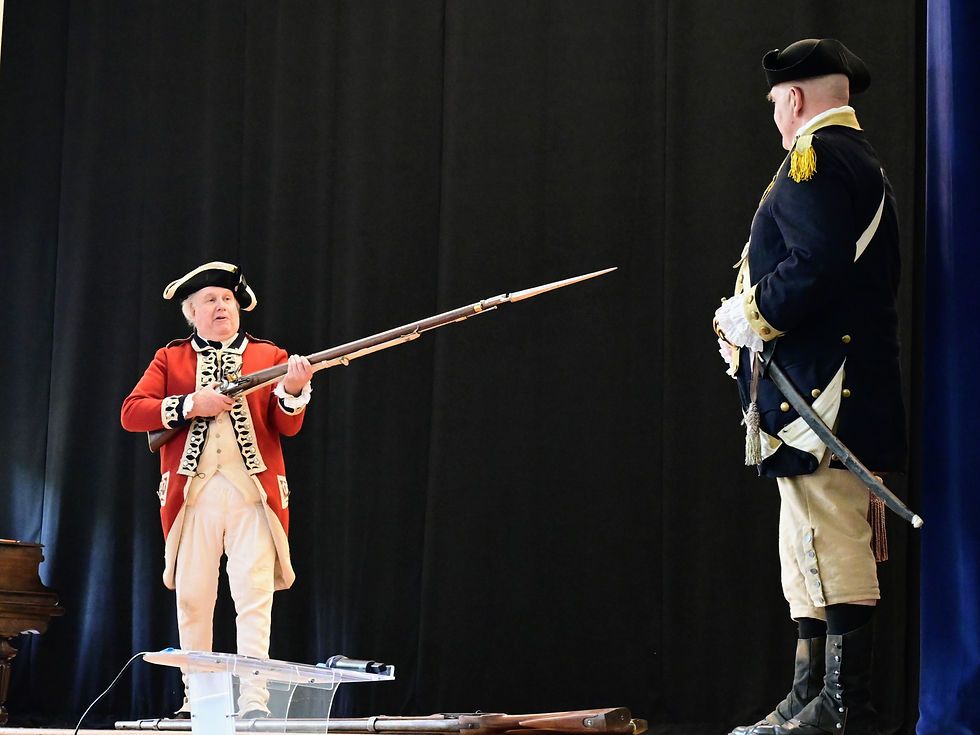
Misenheimer (Greene) noted: "I've heard that he gave an order to dump out the rum. I'm not quite sure men were too pleased with the rum ration that was being dumped out."
Misenheimer (Green) then turned to Niven (the guardsman) and asked: "Were you not cheerful that he disposed of the rum?"
"I'm sure we were none the wiser," said Niven. "We loved General Cornwallis. We considered it an honor to serve under him."
For Cornwallis, the chase was on. "My superior officer wanted me to stay in Charleston and to take care of South Carolina. But I determined to take action and to catch Greene. I very nearly caught you," Dussek/Cornwalls said.
Greene, meanwhile, had decided to divide his army. His plan was to delay Cornwallis.
On January 31st, the day before the Battle of Cowan's Ford, Greene met with his other generals - Davidson, Morgan and Pickens to plot their strategy. They had 4,000 men all along the east side of the Catawba River. They controlled about 40 miles, Misenheimer said, from Tuckaseegee Ford near the modern-day U.S. National Whitewater Center north to Cowans and Beatties fords and still further north to Lookout Shoals Lake.
Cornwallis, meanwhile, had about 2,500 soldiers.
"We did see each other with spy glass," Misenheimer said. "So as we observed each other across the river there."
"We did. Yes, we did," said Dussek. Cornwallis could see the continental forces lined up on a 90-foot bluff above him.
"We made you stop for that day, on January 31st," Misenheimer said.
"We were trying to deceive you, that was what we were trying to do. So we were trying to convince you that we could be crossing any of these fords, and where exactly were we going across? This was part of my strategy," Dussek said.
Said Misenheimer: "We were playing a chess game, sir."
"Yes, we were indeed," replied Dussek.
Gen. William Lee Davidson and his men were at Cowan's Ford, watching to make sure the British did not cross.
Early in the morning on February 1 they did.
"The river was very swollen. And I remember, they crossed bravely, holding their rifles over their heads, and they did force through the stormy water," said Dussek.
Davidson's men were trying to get close to the water and began shooting at the British. As the two sides exchanged fire, General Davidson, on his horse, was shot fatally.
The British successfully crossed Cowan's Ford and marched on. That night, another skirmish happened at Torrence's Tavern, in Mount Mourne. The site is just up NC 115 from Davidson.
Misenheimer and Dussek also talked about how General Davidson's wallet disappeared during the battle. In the mid-20th century, it turned up in a London collection. In 2001, it was returned to Hopewell Presbyterian Church on Beatties Ford Road, where Davidson is buried.


Comments